
Lesson 34 — workflow vs agent. The single most over-claimed distinction in this layer. Most “agentic” deployments are workflows with a marketing budget. That is fine; just call it what it is.
A fixed five-step LLM pipeline is a workflow, not an agent
A team builds an “agentic” customer service system. Under the hood, every request follows the same five steps: classify intent, look up account, draft reply, check policy, send. The LLM never deviates from this path. The system is not an agent. It is a workflow with an LLM inside it. Calling it an agent costs the team explainability and earns them risk classification.
A workflow has a fixed graph of steps. An agent has the freedom to decide which step comes next, possibly to invent new steps. Most production deployments do not need that freedom and pay for it anyway.
The rule: Workflow first. Agent only where decision flexibility is the value, not where it would be nice to have. Agents are 10× harder to operate; reserve them for cases where the alternative is worse.
Workflows fix the steps, agents choose them, and hybrids dominate in practice
- Workflow — a directed graph of steps, possibly with branches. The LLM may make decisions inside a step (classification, generation) but not about which step to take. Observability is high; failure modes are predictable.
- Agent — the LLM decides the next action at each turn. The action set is the set of available tools. The agent may take an unbounded number of steps. Observability is harder; failure modes are creative.
The hybrid pattern dominates in practice: a workflow whose steps are themselves sometimes agentic. The top-level structure is deterministic; the inner loops use agency where it pays.
Workflow, agent, and hybrid each carry a different operational cost and risk profile
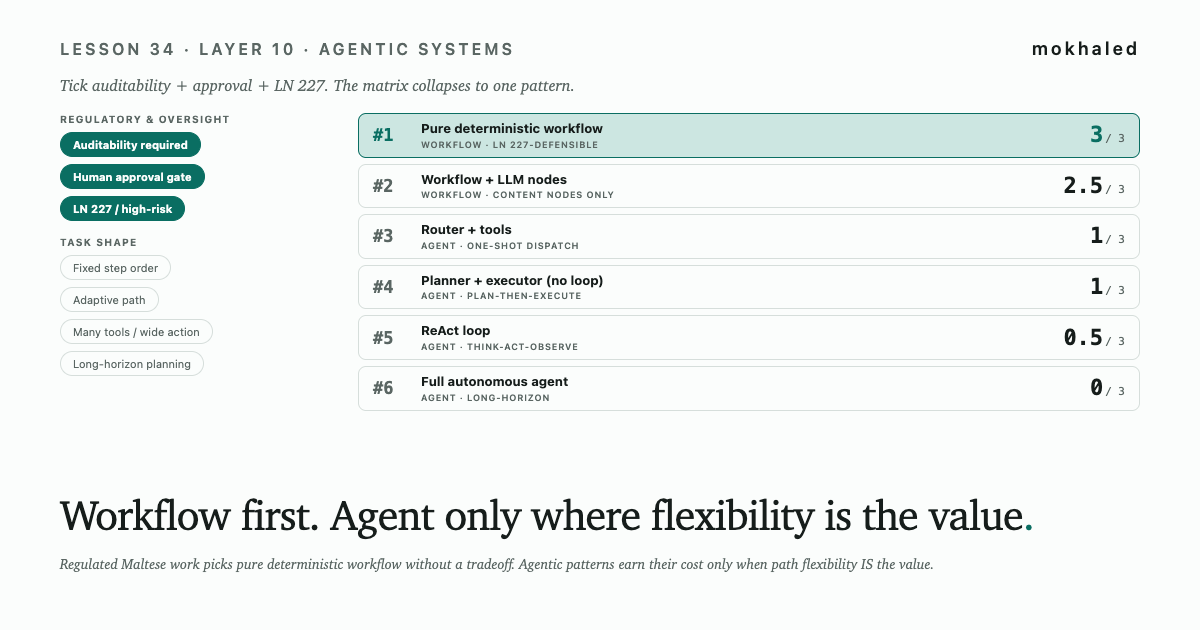
The decision matrix below presents real-world automation tasks. For each, pick workflow, agent, or hybrid. The matrix tells you the operational cost and risk profile of each choice.
Workflow vs agent decision matrix
Six workload archetypes × six architectural patterns. Tick the constraints your workload imposes — patterns re-rank by fit-score (✓ = 1.0, ~ = 0.5, ✗ = 0). Mirrors L22/L31. The doc's headline: 'Workflow first. Agent only where decision flexibility is needed.'
Pure deterministic workflow
WorkflowHardcoded steps, no LLM in the decision path. Most auditable, most boring, dominates regulated work.
- Maltese regulated (LN 227)
- Client-facing production
Workflow + LLM nodes
WorkflowHardcoded skeleton; LLM nodes for extraction / classification / generation inside the deterministic flow. The 80% default for production.
- Maltese regulated (LN 227)
- Client-facing production
- Internal tooling
Planner + executor (no loop)
AgentLLM emits a plan; executor runs steps in order; verifier checks each. No re-planning. Bounded by plan length.
- Client-facing production
- Internal tooling
- R&D / exploration
ReAct loop (think → act → observe → repeat)
AgentClassic agent loop. Model thinks, picks a tool, observes the result, repeats until done. Power-and-risk archetype.
- Internal tooling
- R&D / exploration
Router + tools
AgentLLM picks which tool / path to invoke; one round of selection then execute. The smallest viable agent for many tasks.
- Client-facing production
- Internal tooling
- R&D / exploration
Full autonomous agent
AgentLong-horizon, multi-tool, possibly multi-agent. The frontier; the riskiest pattern. Research and internal tooling only.
- R&D / exploration
Support tickets are workflows, cross-repo investigations are agents, and campaigns are hybrids
“Process this support ticket” looks like an agent task but is usually a workflow. “Investigate this bug across multiple repositories” looks like a workflow but is closer to an agent. “Compose a marketing campaign across channels” is hybrid: top-level workflow with agentic creative steps inside.
For Maltese government workloads, the regulatory framing tightens the choice. Article 14 oversight requires that automated decisions can be reviewed and reversed. Workflows are reviewable; agents are auditable only via traces. For N3-N5 decisional axes (see the three-axis triage), workflows are usually the right answer.
Calling a workflow an agent loses explainability without buying capability
- Call it a workflow if it is a workflow. The marketing-driven “agent” rebrand costs you explainability without buying you capability.
- Agents cost more to operate. Logging, eval, safety, latency-tail management. Pay this cost only when decision flexibility is the unique value.
- Hybrid is usually the answer. A fixed top-level workflow makes the system reviewable; agentic inner steps make the system flexible. Both layers earn their place.